

Wearables
AI smart glasses for the people doing the work.
Hands-free AI that sees what your team sees, answers by voice and shows the next step. We design, build and integrate smart glasses, AI safety glasses and wearable AI applications and tools, from proof of concept to rollout.
Smart glasses
The glasses we build for
We pick the device to fit the job, and test on the real thing before recommending one.









Smart glasses use cases
Hands-free help where the work happens
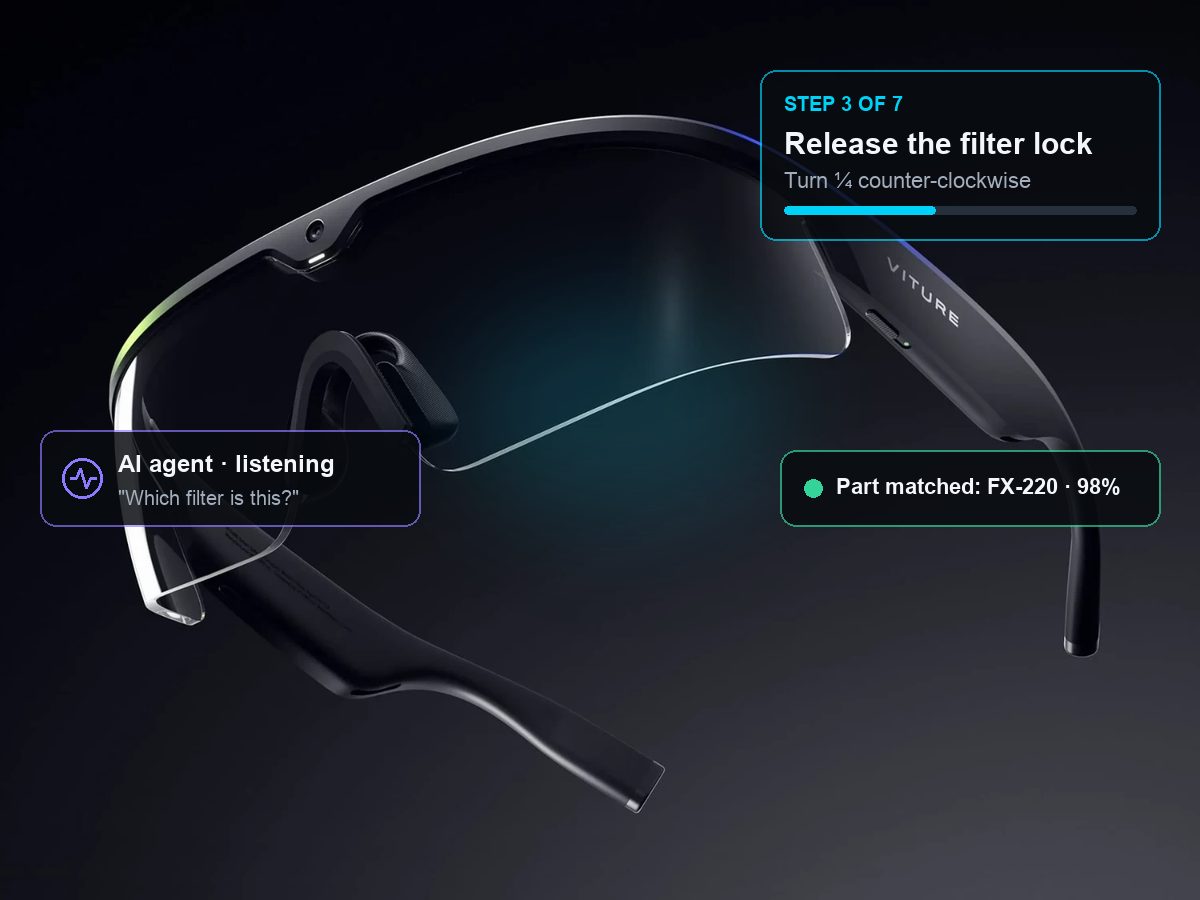
AI glasses see what the wearer sees, answer by voice and show the next step without anyone putting down a tool.
Field technician guidance
Step-by-step repair and install instructions, part recognition and checklists, hands-free on the job site.
Remote expert assist
An expert sees the first-person view, talks the worker through it and marks up what they see.
Warehouse and logistics
Pick paths, scanning and inventory counts with eyes up and hands free.
Manufacturing and quality
Inspection checklists, defect capture and guided changeovers on the line.
Healthcare and clinical
Hands-free notes, procedure guidance and remote consults, within your privacy rules.
Training on the job
An AI coach in the glasses that teaches new staff while they do the real task.
Events, venues and retail
Wayfinding, attendee guides, product info and personalized offers on the floor.
Accessibility and translation
Live captions, translation and reading help for staff and visitors.
Robot training data
First-person capture of experts at work, ready to train robots. See Physical AI.
How a glasses assistant works
Perceive, reason, guide
Perceive
The camera and microphones capture what the wearer sees and says, with spatial mapping for where they are.
Reason
On-device and cloud AI agents recognize parts and steps, and answer from your manuals, tickets and data.
Guide
Heads-up steps, voice answers and remote help. The wearer acts; the glasses keep the next step in view.
What we build
From POC to Pilot to Rollout
Discovery and device choice
We map the job, the site and the constraints, then test candidate glasses with your team.
POC + Pilot
One use case, one team, real work. You see what helps before you commit to more.
Glasses apps and AI agents
Voice, vision and heads-up apps, with agents that answer from your manuals, work orders, tickets and data.
Integration
Connected to the systems you already run: ticketing, maintenance, inventory, ERP, documents and identity.
Rollout and support
Device management, training for the people wearing them, and updates as devices and models change.
Other wearables
Not only glasses
The same AI runs on other things people wear. We also build for smartwatches and rings, AI pins, haptic gloves and EMG wristbands, alone or paired with glasses.
Why now
263% year-over-year growth in AI glasses shipments
First half of 2026 · Counterpoint Research
Need full immersion instead? See XR →
FAQ
Common questions
Which smart glasses should we use?
It depends on the job: display glasses for step-by-step guidance, camera-and-audio glasses for capture and voice help, rugged enterprise models for the field. We test on real devices during discovery and recommend once the use case is proven.
Do the glasses need a display?
Not always. Many tasks work with voice and a camera alone; heads-up steps and overlays need a display model.
What about privacy and cameras at work?
Processing can stay on-device, capture can be limited to set areas or tasks, and retention is agreed with your privacy team.
Do they work with poor signal or none?
Often, yes. Capture, voice and some AI can run on the device or a paired phone and sync when signal returns. We design for the site you have.
Can it connect to our systems?
Yes. Glasses apps are most useful when they read and write to the tools your team already uses, so integration is part of the build, not an extra.
Can we start small?
Yes. Most projects start with one use case, one team and a handful of devices, then grow once the value is clear.
Connect
Put AI where the work happens.
Tell us about the job, the site and the people doing it. We'll show you smart glasses in action and get back to you within a day.