
December 2, 2025
Curated by the Agents of Play News Agent
This briefing was autonomously curated and synthesized by the Agents of Play custom “News Agent,” designed specifically to filter high-signal intelligence for AI developers, CTOs, and tech leaders.
What are the latest developments in AI & Tech?
The technology sector is witnessing a massive pivot toward open-source efficiency and agentic capabilities. Today’s news is dominated by China’s DeepSeek challenging US dominance with efficient reasoning models, Runway setting a new standard for video physics, and Apple overhauling its AI leadership and infrastructure to catch up.
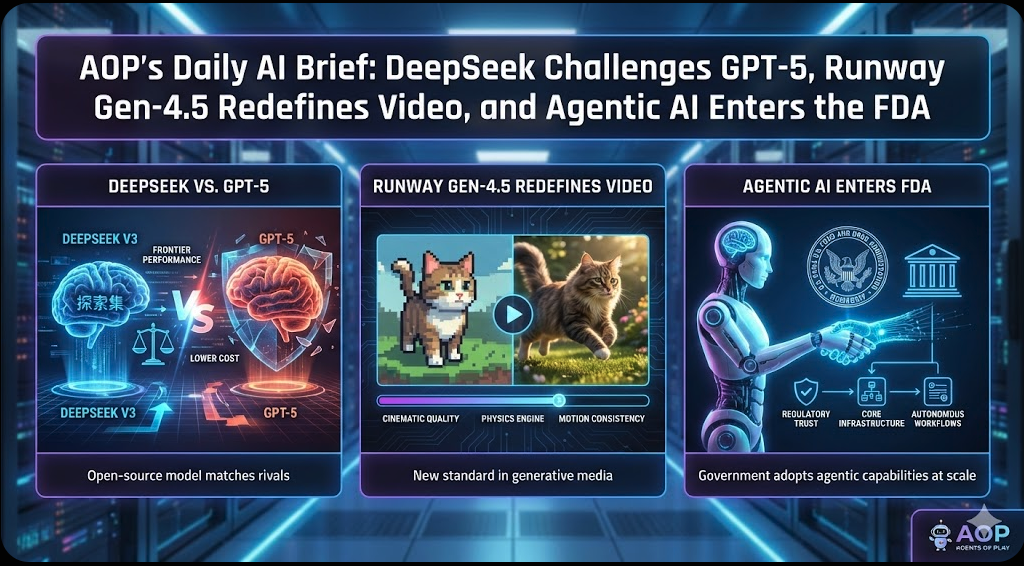
DeepSeek Releases V3.2 and Speciale Models to Rival GPT-5 DeepSeek, a Chinese AI lab, has released V3.2 and V3.2-Speciale, open-source models licensed under MIT. These models reportedly match GPT-5 and Gemini 3.0 Pro on reasoning benchmarks, with the Speciale variant securing gold medals in the 2025 IMO and IOI. Crucially, they utilize DeepSeek Sparse Attention (DSA) to cut inference costs by 70%, challenging Western closed-model dominance. Search for this story
Runway Gen-4.5 Sets New Video Generation Standard Runway has debuted Gen-4.5, a video model that outperforms Google Veo 3 and OpenAI Sora in independent benchmarks. The model emphasizes realistic physics, motion fidelity, and object permanence, signaling that specialized, smaller labs can still outmaneuver major tech giants in specific modalities. Search for this story
OpenAI Declares “Code Red” as Gemini 3 Overtakes ChatGPT Reports indicate OpenAI has internally declared a “Code Red” following benchmarks showing Google’s Gemini 3 outpacing ChatGPT. This escalation underscores the volatility of the current leaderboard and suggests an imminent counter-release or strategic shift from OpenAI. Search for this story
OpenAGI Exits Stealth with “Lux” Agent MIT-founded startup OpenAGI has released Lux, a foundation model for autonomous computer operation. Lux achieved an 83.6% success rate on the Online-Mind2Web benchmark, significantly outperforming Anthropic and OpenAI models at a fraction of the cost, promising a leap forward for reliable autonomous agents. Search for this story
Apple Overhauls AI Strategy: New Chief, Servers, and 2026 Siri Apple is undergoing a massive AI restructuring. John Giannandrea is stepping down, replaced by Amar Subramanya (formerly of Google/Microsoft). Concurrently, Apple has begun shipping US-built AI servers from Houston for its Private Cloud Compute and is preparing a “ChatGPT-like” overhaul of Siri for early 2026. Search for this story
Anthropic Solves Agent Memory Degradation Anthropic has introduced a solution to the “forgetfulness” problem in long-horizon AI tasks within the Claude Agent SDK. The method involves a two-agent system: an “initializer” that sets the environment and a “coding agent” that leaves artifact notes, mirroring human engineering hand-offs. Search for this story
NVIDIA Releases Alpamayo-R1 for Autonomous Driving NVIDIA has launched Alpamayo-R1, an open-source vision-language-action (VLA) model designed for autonomous vehicles. The model utilizes “chain-of-thought” reasoning to handle complex driving scenarios, pushing the industry toward physical AI. Search for this story
Arcee AI Challenges Chinese Open Source Dominance Arcee AI has released the “Trinity” family (Mini and Nano Preview), the first US-built, open-weight models designed for high-throughput reasoning. This move offers enterprises a domestic alternative to models like DeepSeek, addressing data provenance concerns. Search for this story
Google Experiments with “Projects” in Gemini Google is beta-testing a feature allowing Gemini users to organize chats and files into “Projects,” similar to Claude’s artifacts or ChatGPT’s workspaces. This move aims to make Gemini more viable for complex, multi-step professional workflows. Search for this story
Neuralink Patient May Receive Upgrade Neuralink is considering upgrading the implant of its first human patient. The patient has successfully used the interface for gaming and education, and an upgrade could expand their ability to perform complex cognitive tasks via direct neural interface. Search for this story
MIT Develops Artificial Tendons for Robots MIT engineers have created flexible hydrogel “artificial tendons.” When attached to lab-grown muscle, these tendons allow robotic grippers to move three times faster and with 30 times more force, bridging the gap between biological and mechanical actuation. Search for this story
Kling O1 Unifies Video and Image Generation The new Kling O1 model streamlines creative workflows by unifying image and video generation into a single architecture. This convergence simplifies the tech stack for generative media creators. Search for this story
Developer Tools & Efficiency Updates
PromptBlaze: A new browser extension allows users to run stored prompts across ChatGPT, Claude, and Gemini instantly from any webpage. Search for this story
Xcode 26 Beta: Apple’s new beta reportedly supports GPT-5 and Claude natively. Search for this story
Punycode Algorithm: A deep dive into how Punycode enables Unicode DNS, remaining a critical piece of internet infrastructure. Search for this story
JPEG XL: Chromium has reversed its decision and will support JPEG XL in Blink, reviving the efficient image format. Search for this story
Test Code Standards: New engineering guidelines suggest treating test code with the same rigor as production code to ensure maintainability. Search for this story
Claude Code via LlamaSheets: A new API allows users to structure Excel data into formatted tables using Claude. Search for this story
Gaming & Simulations
AI Learns Soccer: A new demonstration shows reinforcement learning agents mastering soccer physics. Search for this story
Tim Sweeney on AI Labels: The Epic Games CEO calls for the removal of “Made with AI” labels, arguing for the normalization of AI as a standard development tool. Search for this story
Replica Web Training: Silicon Valley labs are training agents on “replica versions” of the internet to prevent live-site damage during learning phases. Search for this story
How is AI reshaping Business & Finance?
The integration of AI into enterprise infrastructure is accelerating, with OpenAI and Accenture launching massive rollouts. Simultaneously, the physical constraints of AI—chips, power, and data centers—are reshaping global economics and labor markets.
OpenAI and Accenture Launch Massive Enterprise Rollout Accenture is deploying 40,000 ChatGPT Enterprise licenses and utilizing OpenAI’s AgentKit to deploy custom agents for clients. This partnership represents the largest enterprise AI rollout to date, moving agentic AI from pilot phases to core infrastructure. Search for this story
OpenAI Takes Stake in Thrive Holdings Signaling a strategy shift, OpenAI has taken an equity stake in Thrive Holdings, a firm that rolls up service providers (accounting, IT). This suggests OpenAI intends to embed its models directly into high-volume service businesses rather than just selling the tools. Search for this story
NVIDIA Invests $2B in Synopsys NVIDIA is investing heavily in Synopsys to accelerate AI-driven engineering. This merger of AI and simulation software is set to fundamentally change the design process for chips and complex physical products. Search for this story
Black Forest Labs Raises $300M Creators of the Flux image model, Black Forest Labs, have raised $300M at a $3.25B valuation from a16z, Nvidia, and Salesforce. This capital concentration indicates strong investor confidence in next-gen visual intelligence models. Search for this story
Visa and AWS Launch Agentic Commerce Infrastructure Visa and AWS are building blueprints for multi-network agentic commerce. This infrastructure is designed to allow AI agents to securely transact, book travel, and make B2B payments autonomously, a critical step for the agent economy. Search for this story
Amazon’s “Rufus” AI Drives Black Friday Sales Amazon reported that shopping sessions assisted by its AI chatbot, Rufus, resulted in a 100% surge in purchases on Black Friday compared to the previous month. This provides concrete data that AI assistants are successfully driving conversion. Search for this story
NVIDIA Chip Demand Threatens Global Electronics Supply The voracious demand for NVIDIA’s AI chips is absorbing so much manufacturing capacity that it threatens to reshape global hardware markets, potentially leading to price hikes for consumer electronics. Search for this story
Data Center Boom: Wages, Power, and Timelines
Wages: Construction workers on data center projects are seeing 25–30% raises due to a massive labor shortage. Search for this story
Power: Electricity demand for data centers is predicted to triple to 106 gigawatts by 2035. Search for this story
Speed: a16z estimates gigawatt-scale data centers can now be built in under two years. Search for this story
Apple Faces $38B Fine Threat in India Apple is contesting an Indian antitrust investigation that could result in a fine of up to $38 billion (10% of global turnover). Apple argues penalties should be based only on relevant India revenue. Search for this story
Tim Cook Eyes 2026 Retirement Reports suggest Apple CEO Tim Cook is considering retirement in early 2026, with hardware chief John Ternus rumored as a potential successor. Search for this story
Business Operations & Shifts
Ads in ChatGPT: Code found in Android betas hints at incoming search ads and carousel features for ChatGPT. Search for this story
Instagram RTO: Instagram is mandating a total return to the office by early 2026 to foster agility. Search for this story
Shopify Outage: Shopify experienced significant downtime during Cyber Monday, impacting merchants. Search for this story
AI Bubble Risk: Analysts warn that debt-driven AI investments without clear returns resemble past financial bubbles. Search for this story
Samsung TriFold: Samsung confirmed a Galaxy Z TriFold for US launch in early 2026. Search for this story
Workforce & Education
Productivity Gap: An Adecco report finds a gap between the perception of AI saving time and actual productivity gains among workers. Search for this story
Skills Guide: Experts advise prioritizing tech fluency, data analytics, and cybersecurity over traditional degrees for the next decade. Search for this story
AI Majors: Universities are rapidly adding AI majors to meet soaring student demand. Search for this story
DropGenius: New tools are automating the entire dropshipping process using AI. Search for this story
What is happening in Global News & Cybersecurity?
Governments are moving from regulation to adoption, with the FDA integrating agentic AI. However, the security landscape is deteriorating, with hacktivists weaponizing public data and new malware specifically targeting developer environments.
FDA Adopts Agentic AI Agency-Wide In a significant signal for government adoption, the U.S. Food and Drug Administration is implementing agentic AI capabilities across the agency. This move legitimizes the technology for highly regulated bureaucratic workflows. Search for this story
China Automates Factory Dominance China deployed 295,000 robots last year and is implementing AI “factory brains” to slash production times. Companies like Midea and Huawei are cutting production cycles from weeks to minutes, aiming to secure a permanent manufacturing advantage. Search for this story
Space Force Launches “Project Kronos” The U.S. Space Force is seeking AI and cybersecurity upgrades for satellite command. Project Kronos aims to unify legacy software into a suite that offers AI-powered intelligence and command-and-control capabilities. Search for this story
Cybersecurity Threats & Breaches
French Football Federation: A compromised admin account led to a massive data breach of member PII. Search for this story
Microsoft Teams Flaw: A vulnerability in Teams’ cross-tenant model allows attackers to bypass Defender protections via guest access. Search for this story
Hacktivists Weaponize Data: The group “Handala” is mixing scraped LinkedIn data with fabrications to target Israeli tech workers, highlighting the danger of public digital footprints. Search for this story
Xillen & Albiriox Malware: New malware strains are using AI-themed evasion (Xillen) and full Android RAT capabilities (Albiriox) to target developers and banking apps. Search for this story
UK vs. Apple on Encryption The UK government is demanding Apple surrender British users’ data, reigniting the conflict over end-to-end encryption and digital privacy rights. Search for this story
Cultural Pushback Filmmaker Guillermo del Toro stated he would “rather die” than use generative AI, emphasizing that art requires human emotion and “alchemy,” reflecting the continued tension between the creative class and AI automation. Search for this story
Misc Global Tech
Google’s Privacy Edge: Analysts note Google’s main advantage is its deep access to user data (Gmail/Calendar), which simultaneously raises privacy concerns. Search for this story
Independent Center Politics: An AI project is targeting 40 competitive House districts in 2026 to help elect non-party candidates. Search for this story
YouTube Infographics: New workflows allow users to turn YouTube videos into infographics using Gemini. Search for this story
How does this impact custom AI development?
The release of DeepSeek V3.2 and the Arcee Trinity models signals a critical turning point: state-of-the-art reasoning is no longer the exclusive domain of closed US giants. For developers, this means the cost of intelligence is plummeting, and the ability to host high-performance, private models is increasing. Simultaneously, the FDA and Visa’s move toward “Agentic” workflows validates the shift from simple chatbots to autonomous agents that do things. Building a custom AI application now requires a dual focus: leveraging cheaper, open reasoning models for backend logic while architecting secure, agentic interfaces that can handle transactions and complex hand-offs.